
Lovely Lovage
A magical herb

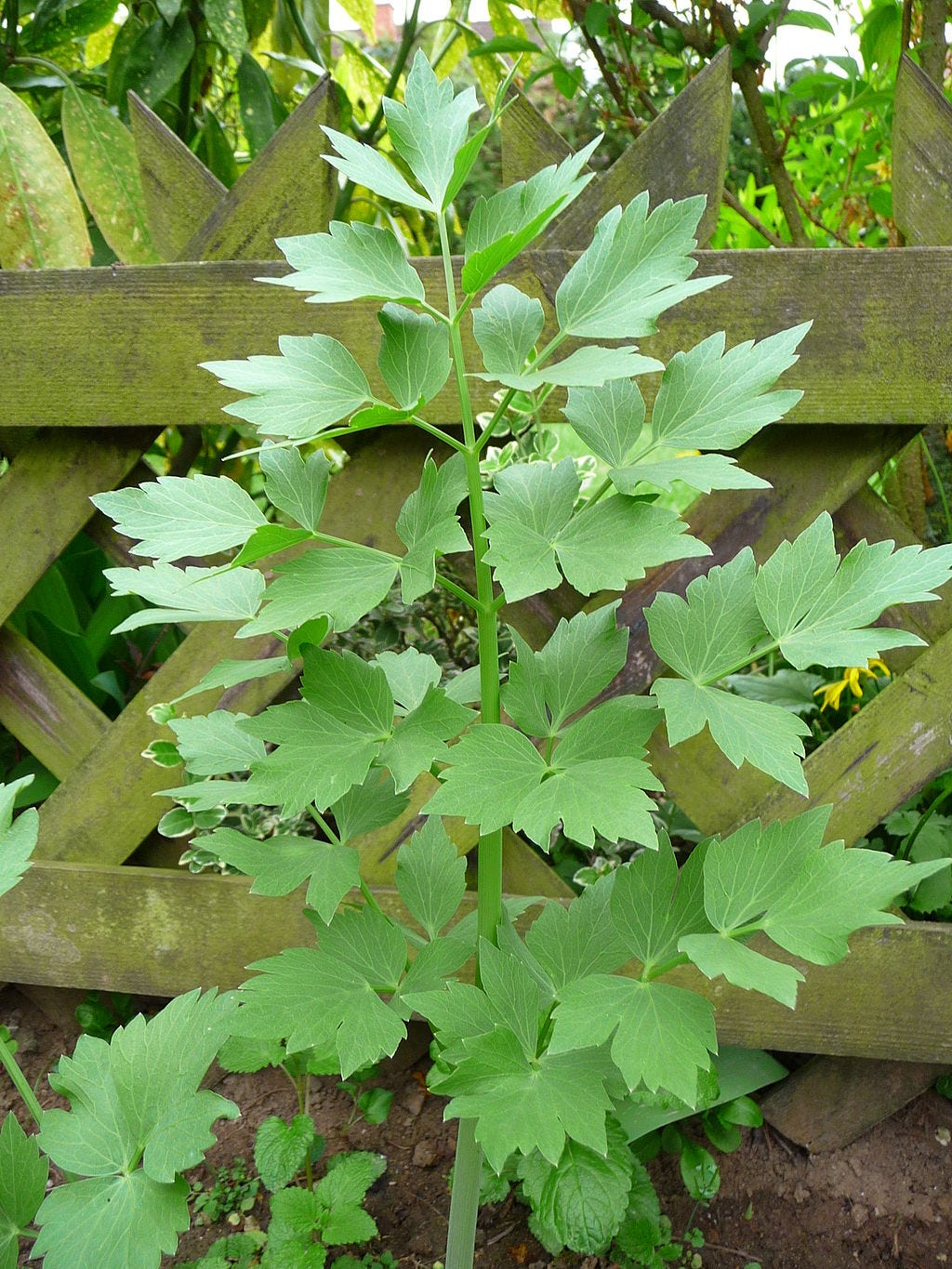
Lovage Levisiticum officinalis is native to Iran and Afghanistan but now grows in temperate regions worldwide. The parts used medicinally are the leaves, roots and seeds.
History
Lovage was used both for medicine and in cooking by the Greeks and the Romans. Dioscorides mentioned it in his books (Greek: ligusticon) as do Roman authors Pliny, Apicius and Galen (Latin: ligusticum) which may reflect the fact that Lovage grew in Liguria, Italy. The name may have come from from the Latin levare, meaning ‘to lighten’ or ‘to alleviate.’
Lovage was introduced into Britain by the Romans and was widely used for culinary and medicinal purposes. In Chaucer’s day it was called ‘love parsley’ as it was often used in love potions and rituals. Brides wore Lovage in their hair or carried sprigs on their dresses to bring good fortune and a happy marriage. Lovage was also placed under mattresses or beds to repel negative energies and attract fertility and love. A bundle of Lovage leaf tied with coloured threads (usually red, green, and white) was buried in a new house’s foundation to invite harmony and prosperity for the family. A Lovage bath was considered a powerful ritual practice before magical workings and important events such as dates or social gatherings to purify negative energies.
Traditional Uses
Lovage was used in the 12th century to relieve abdominal pain, heart conditions and for digestive complaints to reduce flatulence and colic, cough and lung congestion. It was used by the School of Salerno1 as a natural remedy to support the liver and treat jaundice. Traditional herbal practitioners consider Lovage to be an effective natural diuretic and also use it to treat kidney stones2.
Lovage was used to purify the blood and used for gout, rheumatism and skin eruptions. Hildegarde recommends Lovage for pleurisy as a mild expectorant combined with Sage and Fennel. Lovage has also been used in traditional medicine to treat headaches, migraine, sore throats, pleurisy and malaria.
Modern virtues:
Aromatic, stimulant, diuretic, warming, expectorant, antioxidant, anti-inflammatory and antimicrobial.
Lovage helps to loosen the build-up of excess mucus from the respiratory system and expels phlegm. It contains eucalyptol which can reduce irritation of the lungs.
Lovage is natural diuretic known as an aquaretic a kind of diuretic which stimulates the production of urine without the usual loss of electrolytes.
Lovage is tonic for the skin. It has antioxidant and anti-inflammatory properties used for or chronic skin conditions like psoriasis both internally and as a lotion of cream. It is also thought to increase the flow of blood to the skin’s surface which helps improve its appearance and tone.
Lovage is used for digestive complaints including flatulence, indigestion and stomach pain. Its anti-inflammatory properties help it to soothe irritation in the bowels and restore healthy colon function. Lovage is added to rich foods to help digestion.
Science
Lovage was very effective against various harmful organisms including E,coli, H.pylori and salmonella3.
Two fractions, falcarindiol and the fatty acids oleic acid and linoleic acid showed antibacterial activity but only in combination. Thus the whole plant needs to be used, not isolated extracts. [Garvey 2011]
The anti-inflammatory and antimicrobial actions are due to the presence of quercetin, eugenol and limonene.
Quercitin, the flavonoid antioxidant is anti-allergic by inhibiting the release of histamine. It reduces oxidative stress caused by the free radicals4. Quercetin is an inhibitor of mast cell secretion and causes a decrease in the release of tryptase. 5
Lovage essential oil shows antibacterial activity against both Gram positive and Gram-negative bacteria and is one of ten essential oils (thyme, cinnamon, bay, clove, almond–bitter, pimento, marjoram, angelica, nutmeg) with strongest activity compared to 25 essential oils tested6
I will be speaking on The Astrology of Earth Magic at the Earth, Sea and Sky Conference tickets here

Culpeper
‘Government and Virtues. It is an herb of the Sun, under the sign Taurus. It is cutting, opens and digests humours, warming, digestive. If Saturn offends the throat, this is your cure.’
It opens, cures, and digests humours, and provokes women’s courses and urine. [see below for its contraindication in pregnancy]
A dram at a time of the dried root in powder taken in wine, warms a cold stomach, helps digestion, and consumes all raw and superfluous moisture therein; eases all inward gripings and dissolves wind, [warming remedies improve digestion as heat is needed for this process.]
[Lovage] resists poison and infection. [see above for the science of this]
The decoction of the herb is a remedy for ague, and pains of the body and bowel which proceed from cold. (These will be dull, constant, grinding, boring kinds of pain). The seed is more powerful. [Its anti-inflammatory and anti-histamine action]
The distilled water is helpful for quinsy of the throat if gargled with and helps with the pleurisy. [the anti-bacterial and anti-inflammatory actions of eucalyptol]
It takes away dimness and redness of the eye if dropped in them (the Sun rules the right eye in men and the left eye in women).
The leaves heated in hog’s oil will break a boil. [its antibacterial properties]
Emotional Uses
Lovage as a herb of the Sun builds Vital Spirit and improves mood. It works on the heart to build self-esteem, bringing a feeling of calm and peace.
Magical
Lovage, because of its light, airy quality is in dream work, visions and path workings. It is purifying and can be used to consecrate a sacred space, for aura cleansing and healing work to lift the mood.
Lovage is often used as a bathing herb as it has a delicate smell and is mood elevating as well as purifying from negative energies.
Mix with Rose and Melissa to draw loving energy towards you and to serve others as a tea to have harmonious meetings.
Caution
Lovage may increase photosensitivity7
Lovage contains Coumarins (furanocoumarins) which inhibit blood clotting which may interact with anticoagulants, such as warfarin.8
Lovage induces shedding of the uterine lining so avoid in pregnancy. 9
See my Women Healers through History, Aeon Books, for a discussion on Trota of Salerno https://health.aeonbooks.co.uk/product/women-healers-through-history/93254
https://pubmed.ncbi.nlm.nih.gov/21194895/ Garvey, Mark I et al. “Medicinal plant extracts with efflux inhibitory activity against Gram-negative bacteria.” International journal of antimicrobial agents vol. 37,2 (2011): 145-51. doi:10.1016/j.ijantimicag.2010.10.027
https://healthyfocus.org/quercetin-benefits/] [https://pubmed.ncbi.nlm.nih.gov/21625024/
https://www.ema.europa.eu/en/documents/herbal-report/draft-assessment-report-levisticum-officinale-koch-radix_en.pdfhttps://www.ema.europa.eu/en/documents/herbal-report/draft-assessment-report-levisticum-officinale-koch-radix_en.pdf
Kennedy DA, Lupattelli A, Koren G, Nordeng H. Safety classification of herbal medicines used in pregnancy in a multinational study. BMC Complement Altern Med. 2016;16(1):102. doi:10.1186/s12906-016-1079-z
Such a rich post -- i haven't worked much with lovage and this really drew me in.