
Mystical Mistletoe
a powerful herb of deep midwinter

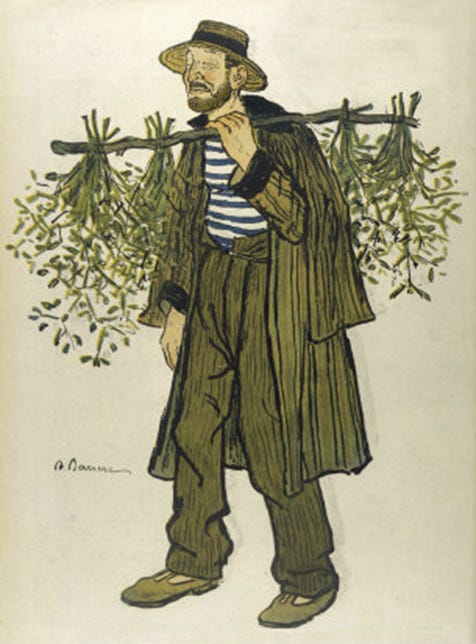
I have a midwinter ritual involving Mistletoe. In the days before the Winter Solstice I collect Mistletoe, given I live in a city this involves seeking out flower stalls which might, or once did sell it. It is always a journey as for some reason the same flower seller never has it two years running. On solstice day I take last year’s bunch, which hangs by my front door and take it to a river and throw the dried out stalks into running water, discarding the year as I do. The new bunch is tied with a red ribbon and hung up on my altar for the twelve days of Christmas and on twelfth night (January 5th) when all the decorations come down, the Mistletoe is hung by my front door for another year.
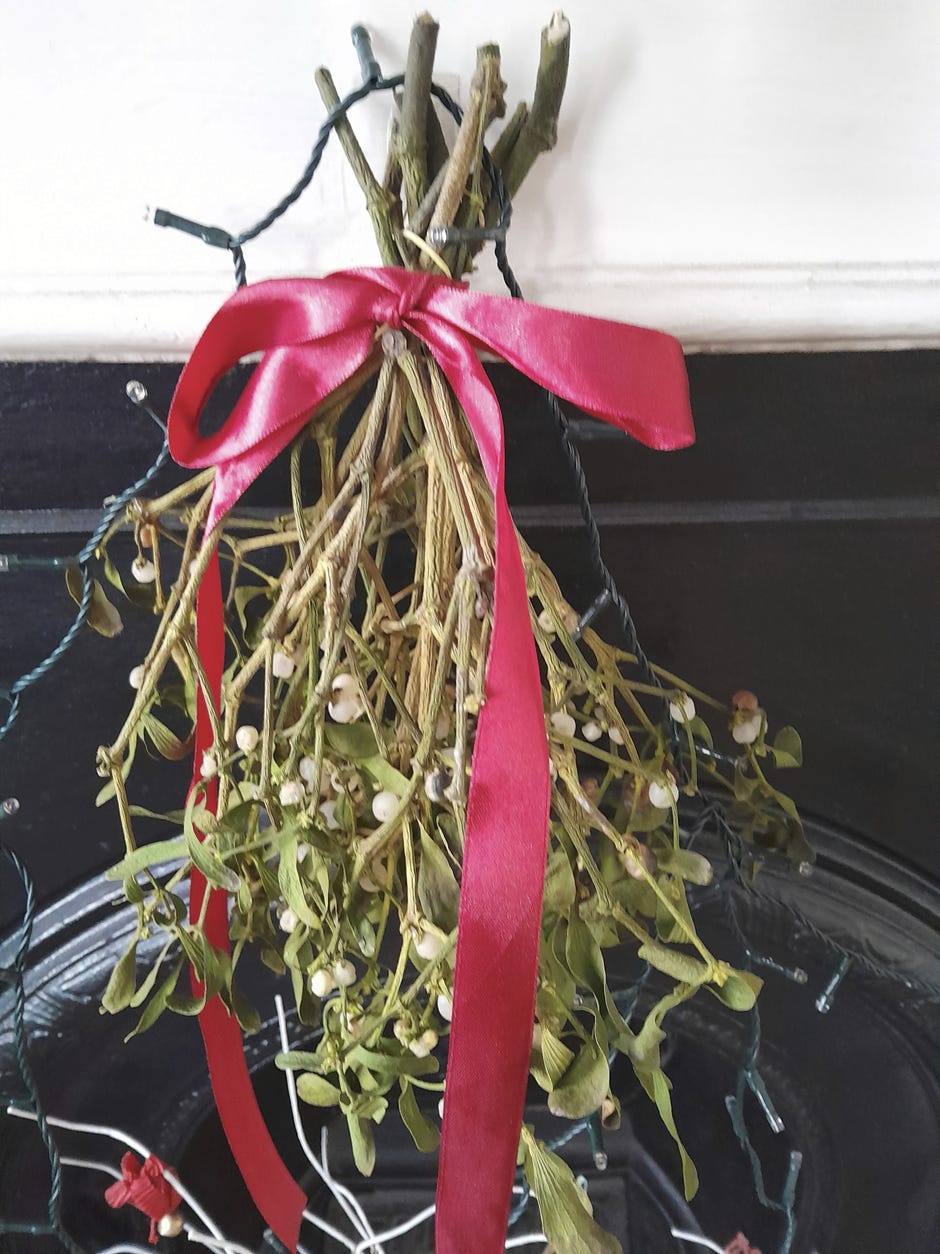
The word 'mistletoe' derives from the Old English misteltan Old High German and Old Norse mistil. The Greek ἰξóς ixós means both mistletoe, plant and berry as well as birdlime [a sticky substance smeared on branches to trap birds]. Birdlime also refers to anything which sticks, which may refer to Mistletoe’s magical properties. Viscum the Latin name also refers to stickiness, the word viscid comes from this root.
Sacred to the Druids and other European pagan traditions, the semi parasitic nature of Mistletoe which emerges from the branches of many kinds of trees, Oak, Apple, Almond, Fir Hawthorn and Ash among them. Mistletoe seems magical, especially in deciduous trees as bunches are revealed in autumn as leaves have fallen from the tree. It was believed, correctly as it turns out, that the type of tree it grows on affects its properties. Mistletoe is semi-parasitic, it takes water and some nutrients from the host tree, while also carrying out photosynthesis on its own leaves.
Traditional Uses
Use of Mistletoe was recorded by Hippocrates for diseases of the spleen and complaints associated with menstruation. The goddess Athena, was known as the 'mistletoe user’. In healing rituals Mistletoe growing in the branches of sacred oaks in the healing temples of Asclepius (there were over 200 of these in Greece) had the symbolic meaning of castrating the host tree because the juice from mistletoe berries, seen as the 'oak sperm' was seen to have powers of regeneration.1
Roman Pliny the Elder used mistletoe to treat epilepsy, infertility and ulcers. In the Middle Ages, Paracelsus also recommended mistletoe as a treatment for epilepsy. Hildegard von Bingen described mistletoe as a treatment for diseases of the spleen and liver. Mistletoe was also applied for deworming children, to treat labour pains, gout, affections of the lungs and liver, leprosy, mumps, fractures and hepatitis. During the eighteenth century, mistletoe was applied for “weakness of the heart” and oedema. In Japan, mistletoe was used to treat hypertension, spasms of the heart, rheumatic pain, threatened abortion and locally to treat frostbite. In India, a tea prepared from mistletoe leaves was used to treat diabetes.
Culpeper
This is under the dominion of the Sun, with something of the nature of Jupiter. Both the leaves and berries do heat. mollifies hard knots, tumours, and… Made into powder, and given to drink, it is good for the falling sickness. Misseltoe is a cephalic and nervine medicine, useful for convulsive fits, palsy, and vertigo.’
Herbs of the Sun strengthen Vital Spirit, support the heart and build resistance to disease.
Science2
The main active compounds are lectins, viscotoxins, flavonoids, phenolic acids, sterols, lignans, terpenoids, phenylpropanoids, alkaloids and fatty acids.
Mistletoe has been studied as an anti-cancer and immune system regulator. Extracts for subcutaneous or intravenous administration of Viscum have been shown to improve the quality of life and survival of cancer patients.
Mistletoe may be helpful to treat hypertension, diabetes, liver diseases, epilepsy and Alzheimer’s disease.
Viscum has been shown to improve endurance and muscle strength, enhance wound healing and as antibacterial and anti-fungal agent.
The chemical composition of mistletoe depends on the part of the plant (stem, leaves, fruits) and host species as well as the place and time of harvest.
To date, the active compounds responsible for the individual pharmacological activities of mistletoe have not been identified. It may be there are individual isolated active compounds, but the therapeutic effect of mistletoe might be a result of the action of the whole plant constituents, e.g. phenolic acids, flavonoids and fatty acids and viscotoxines and lectins. Postulated actions of Mistletoe include acting on membrane receptors, enzymes, ion channels, transporter proteins and transcriptional targets.
Modern Therapeutics
** Mistletoe is a schedule 20 herb**3
Mistletoe therapy4 has been used alongside conventional cancer treatment to: boost immune function. Improve energy and reduce cancer-related fatigue5 and to support emotional resilience and reduce anxiety. It may alleviate symptoms in conditions like ME/CFS, fibromyalgia, multiple sclerosis, and insomnia and generally enhance the quality of life and well-being [Vital Spirit]. However, alternative treatments for cancer side effects are a political hot potato, as responses to the paper (Troger 2014) demonstrate.
Going back to Culpeper, supporting the Vital Spirit (like Qi or Prana) gives the best chance to overcome multiple chronic disease symptoms and treatment side effects. It can never be a miracle cure though, as Hippocrates saw thousands of years ago, illness is a psycho-social-biological event, body, mind, spirit, emotions and social conditions need to be taken into consideration in any healing paradigm.
Magical Uses
Mistletoe is a symbol of the Winter Solstice, the longest night and the return of the light. The berries yield a sticky, white substance, which some liken to semen, and hence there is a fertility aspect to the plant.
The stickiness [see above] may also refer to its ability to integrate and harmonise energies in the body.
The tradition of hanging Mistletoe by the front door is a protective measure, and also to bring love into the home and nourish it.
Magically, as a herb of the Sun, Mistletoe brings light into the darkest days, banishing dark emotions such a jealousy and hate, allowing the inner light of the Soul to shine through. Herbs of the Sun are powerful in this way, they bring brilliance back to tarnished situations of the body, mind and emotions. It is helpful during deep seated and long lasting conditions to bring insight and illumination.
Mistletoe has powerful, good, masculine energy, it is full of life force, sexuality and sensuality. Use for midwinter warmth and light and for erotic celebrations and feasting.
Fornaro, Michele et al. “Medicine and psychiatry in Western culture: Ancient Greek myths and modern prejudices.” Annals of general psychiatry vol. 8 21. 7 Oct. 2009, doi:10.1186/1744-859X-8-21
Szurpnicka, A., Kowalczuk, A. & Szterk, A. Biological activity of mistletoe: in vitro and in vivo studies and mechanisms of action. Arch. Pharm. Res. 43, 593–629 (2020). https://doi.org/10.1007/s12272-020-01247-w
https://www.legislation.gov.uk/uksi/2012/1916/schedule/20
https://www.anthroposophicdoctor.co.uk/mistletoe-therapy/
Tröger, Wilfried et al. “Quality of life of patients with advanced pancreatic cancer during treatment with mistletoe: a randomized controlled trial.” Deutsches Arzteblatt international vol. 111,29-30 (2014): 493-502, 33 p following 502. doi:10.3238/arztebl.2014.0493
I love mistletoe and what a gorgeous illustration. I try to hand some over this period too, but had never thought of letting it hang on the door from epiphany -- wonderful idea.