
Sizzling Saffron
a herb of power

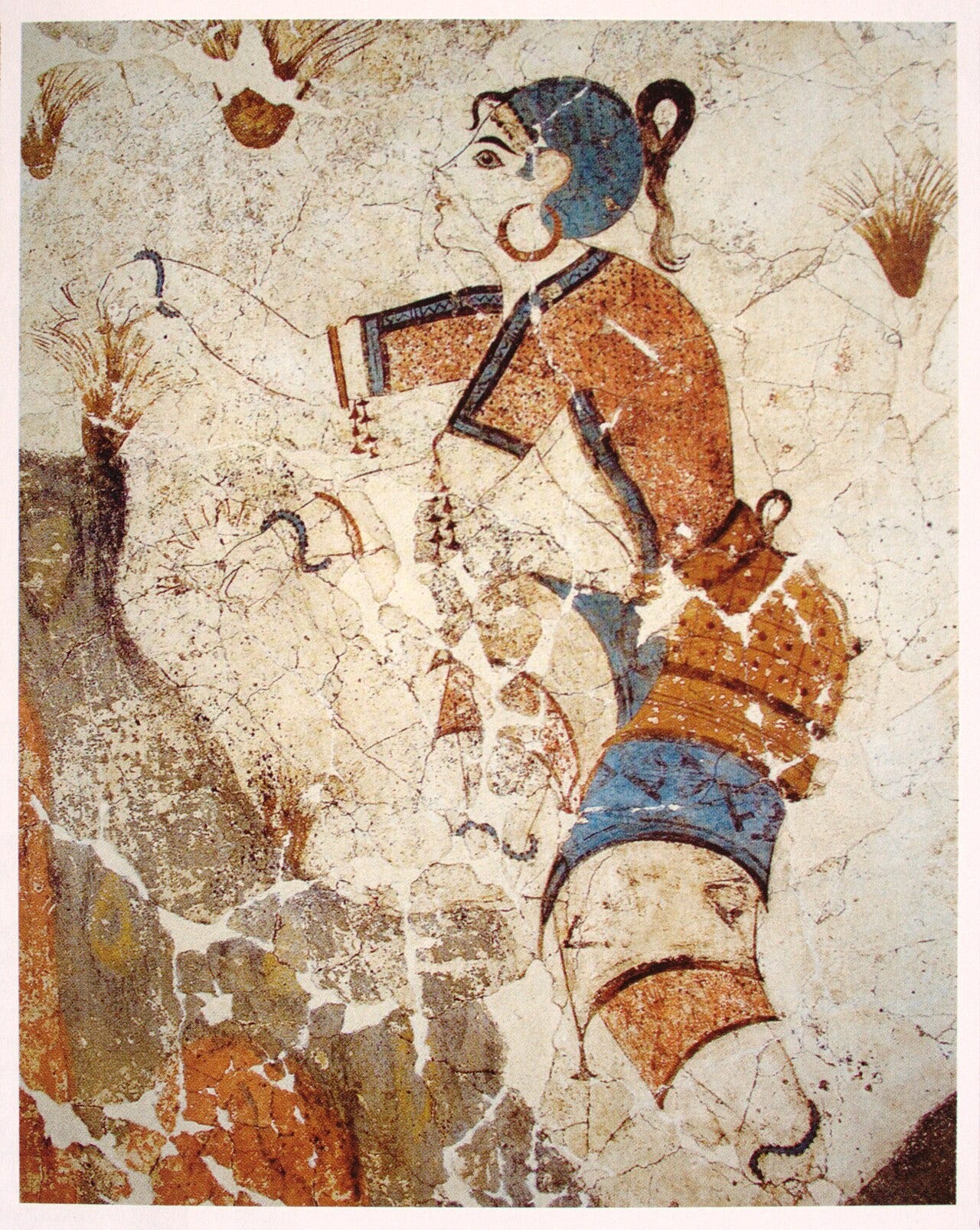
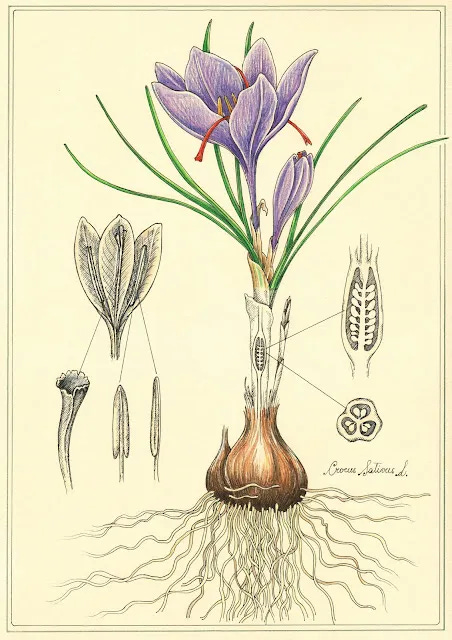
Saffron, (Crocus sativus) is the herb made from the stigma and styles of the Crocus. Saffron originated in or near Greece, Iran, Kashmir or Mesopotamia and was traded throughout Eurasia. As the fresco above attests, Saffron was a prized herb. The name Saffron may come from the Persian, zarparān which means ‘golden strung’ referring to the deep golden colour of the herb.
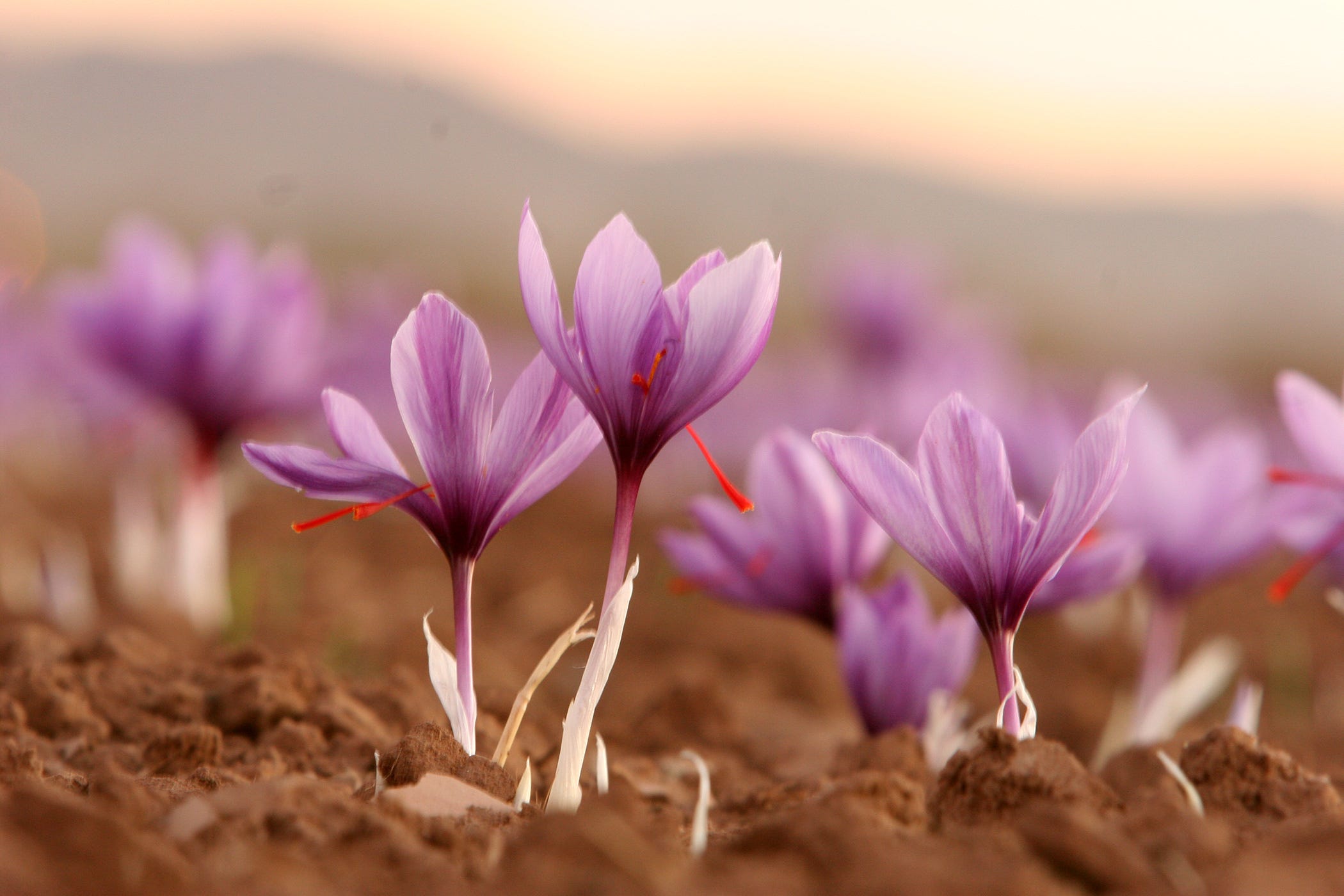
Saffron can be grown in the UK, the town of Saffron Walden in Essex takes its name from the plant.
Culpeper tells us,
‘Saffron grows in various parts of the world, but is no where better, if so good, as in England. At present it grows plentifully in Cambridgeshire, and in that large tract of ground between Saffron-Walden, and Cambridge.’
History
Saffron (Crocus cartwrightianus) was traded by the Minoans throughout the mediterranean and beyond over 3,000 years ago. Numerous illustrations including the fresco above suggests the importance of the herb in their culture and perhaps their rituals. Saffron-based pigments have been found in 50,000-year-old paintings in northwest Persia (Iran). Persian saffron (Crocus haussknechtii) was cultivated from at least 1000 BCE. Saffron threads were woven into textiles, ritually offered to divinities, and used in dyes, perfumes, medicines, and body washes. Saffron threads were scattered across beds and mixed into hot teas as a curative for bouts of melancholy. During his Asian campaigns, Macedonian Alexander the Great, following the Persian practice, used Saffron in baths to heal battle wounds and is credited with the introduction of saffron-bathing to Greece. Hetaerae (Greek courtesans) used saffron in scents, waters and pot pourri as aphrodisacs and as offerings to Ahrodite. Saffron was used by Egyptian perfumers, doctors in Gaza, by the people of Rhodes, while the Phoenicians (Lebanon and Syria) sold Kashmiri saffron as a dye and a treatment for melancholy. 1
Culpeper gives Saffron to the Sun,
‘It is an herb of the Sun, and under the Lion [Leo], and therefore you need not demand a reason why it strengthens the heart so exceedingly. Let not above ten grains be given at one time, for the sun, which is the fountain of light, may dazzle the eyes and make them blind; a cordial being taken in an immoderate quantity, hurts the heart instead of helping it. It quickens the brain, for the Sun is exalted in Aries, as well as he has his house in Leo: it helps consumptions of the lungs, and difficulty of breathing: it is excellent in epidemical diseases, as pestilence, small-pox, and measles. It is a notable expulsive medicine, and a good remedy for the yellow jaundice..’
He warns against excess use,
‘is a very elegant and useful aromatic, of a strong penetrating smell, and a warm, pungent, bitterish taste. It is said to be more cordial, and exhilarating than any of the other aromatics, and is particularly serviceable in disorders of the breast in female obstructing, and hysteric depressions. Saffron is endowed with great virtues, for it refreshes the spirits, and is good against fainting-fits, and the palpitation of the heart: it strengthens the stomach, helps digestion, cleanses the lungs, and is good in coughs. It is said to open obstructions of the viscera and is good in hysteric disorders. However, the use of it ought to be moderate and seasonable; for when the dose is too large, it produces a heaviness of the head, and a sleepiness; some have fallen into an immoderate convulsive laughter, which ended in death. A few grains of this is commonly a dose, though some have prescribed it from half a scruple to a scruple and a half.2
Science would agree:
‘There are clinical trials conducted, evaluating the efficacy of saffron in mild-to-moderate depression. The studies reported that saffron was more effective than placebo and at least equivalent to the therapeutic doses of imipramine and fluoxetine.’3
Pharmacology4
Saffron contains carbohydrates, minerals, mucilage, vitamins B1 and B2, and pigments. Crocin, crocetin, carotene, lycopene, and gigantic anthocyanin, alpha-carotene, beta-carotene, and zeaxanthin are the oil-soluble pigments that can be found in the stigma. The colour of saffron is due to the degradation of carotenoid crocin. The main phytochemicals believed to be responsible for the activity of C. sativus are crocin, picrocrocin, and safranal.
Crocin and saffron extract have been found to prevent memory and spatial learning impairment caused by chronic stress. It is likely the prophylactic action of saffron against memory loss is due to its antioxidant action. Studies have shown saffron extract to be as efficient as imipramine during a double-blind and randomized trial conducted over 6 weeks for mild-to-moderate depression. Crocin (30 mg/day), was found to increase the effects of selective serotonin reuptake inhibitors in treating patients with mild-to-moderate depression with the absence of substantial side effects.
*** some preliminary research has shown abortifacient effects of Crocin, so avoid in pregnancy.***5 although Saffron is traditionally used as a galactague and for overall post-partum health.
Theraputics
Herbs of the Sun boost the Vital Spirit, which is to be compared with Qi or Prana in TCM and Aruvedic medicine. Vital Spirit increases vitality, promotes health and wellbeing, resists disease and keeps the mood elevated. We dissipate Vital Spirit by poor diet, prolonged stress, unhappinness, lack of sleep and overworking. We conserve Vital Spirit by nourishing body, mind, spirit and emotions.
Saffron then, will be helpful recovering from chronic, debilitating illness, post viral and similar conditions, once the symptoms have subsided and exhaustion and debility remain.
Saffron is a useful herb during the menopause, when energy can be low and the body may feel depleted and exhausted. Mixing with Wild Oat would be helpful to nourish the nervous system. Similarly, it can be helpful in premenstrual stress and depression.
However, as Culpeper says, too much of a good thing slips into its opposite, very fiery people should only take Saffron for short periods at low doses.
This is a remedy for cold and stagnation.
Dementia can respond to Saffron as this is also a withdrawl from life, from a variety of causes, a cooling and slowing down of the brain, a lack of energy and engagement in life or depression.
Emotional
This is a powerful and perhaps disturbing remedy which uncovers and releases pent up and supressed emotions such as grief and rage and brings renewed vitality and strength.
Hence its use to alleviate the symptoms of depression which can be caused by ‘swallowing’ the emotions. Note that 80% of cases of autoimmune disease are found in women and women in unhappy relationships who don’t express their feelings are doubly vulnerable.
Its use in depression makes perfect sense, bringing fire, and doubtless anger to the surface and re-kindling the Vital Force.
Consequently, Saffron gives tremendous creative power, release, energy and dynamism. For this reason it is best avoided in delicate states as it may be too strong to bear and over heated people as it will be too energising.
Magical Uses
This is a herb of midsummer. A little in a potion will bring exuberance and energy to celebrations.
Saffron is used widely in magic, because of its powerful solar energy. It is a remedy for protection, cleansing spaces and banishing negative influences.
Saffron has aphrodisiac properties and may be used for that purpose, to attract and enhance lovemaking.
Saffron may increase spiritual energy as it is connected with the Sun and consciousness. It has an affinity to the third eye, for far seeing and intuition, pathworking and trials of courage.
Saffron can reconnect us with a vibrant life force if we are grieving or have suffered trauma which has floored us. Small doses help to build internal fire.
Saffron is used in baths as well as teas and lotions for all these effects.
https://en.wikipedia.org/wiki/Saffron
1 scruple=1.26 g. I grain is 1/20th of a scruple.
Siddiqui, Mohammad J et al. “Saffron (Crocus sativus L.): As an Antidepressant.” Journal of pharmacy & bioallied sciences vol. 10,4 (2018): 173-180. doi:10.4103/JPBS.JPBS_83_18. https://pmc.ncbi.nlm.nih.gov/articles/PMC6266642/
Siddiqui et al (2018). https://pmc.ncbi.nlm.nih.gov/articles/PMC6266642/
Schmidt et al. (2007). https://pubmed.ncbi.nlm.nih.gov/17704979/
Love this. I have a tiny amount of saffron in a tincture I'm currently using. That ability to move things -- from emotions to circulation -- is wonderful -- but definitely small doses